
Ohm's law Calculator

Ohm's Law Power Wheel
A quick reference quide to the key formulas used in electronic calculations.
How to use: Cover the quantity you want to find, and the formula directly above it will show how to calculate it using the other two quantities.
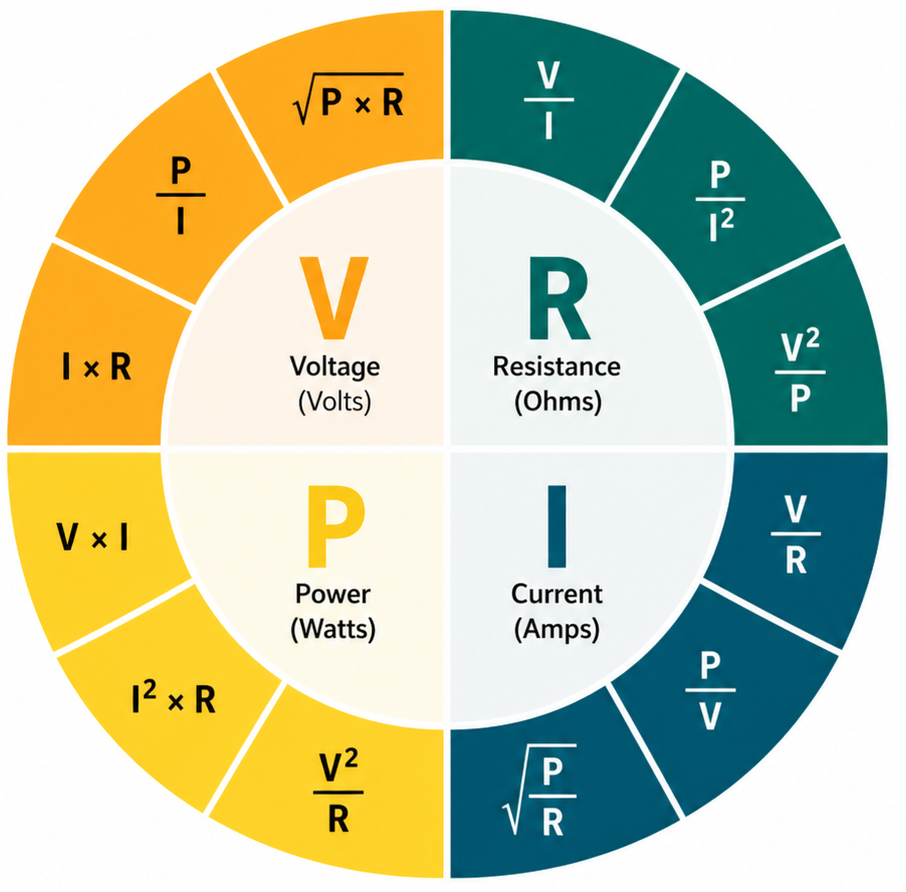
Ohm’s Law is one of the core principles of electrical engineering, defining the relationship between voltage, current and resistance within a circuit. It explains how electrical current flows and how different factors influence that flow.
In simple terms, the current flowing through a conductor is directly proportional to the voltage applied, and inversely proportional to the resistance in the circuit. This relationship makes Ohm’s Law an essential tool for analysing and designing electrical systems.
Ohm’s Law can also be used alongside power calculations. Electrical power describes the rate at which energy is transferred or converted within a circuit, such as into heat, light or motion. Power is measured in watts (W) and is closely linked to voltage and current.
Ohm’s Law Calculator
Calculate voltage, current, resistance and power by entering any two known values.
Understanding Ohm's Law
Ohm’s Law is commonly expressed using the formula:
V = I × R
Where:
- V = Voltage (Volts)
- I = Current (Amps)
- R = Resistance (Ohms)
This formula can be rearranged depending on which value you need to calculate, making it a flexible and widely used tool in both practical and theoretical applications.
By entering any two known values into the calculator above, the remaining values can be calculated instantly.
The results provided by this calculator are intended as a guide only. While care has been taken to ensure accuracy, Charcroft Electronics does not accept responsibility for any errors or omissions. All results should be independently verified before being used in design, specification or application.